

Analysing solar panel tilts
By tilting the panels we can generate more energy from the sun, especially in sun. But how practical is that and is the extra tilting really worth all of the trouble?

Sam Bendat
Updated: August 20, 2024
To tilt solar panels or to not tilt?
Tilt means the pitch or angle at which the solar panels are installed.
I'm going to break down if the tilt of solar panels matters in generating more solar energy and, if it does, what's the best option. I'm using my mum's real consumption data and her home to model the different tilts.
A higher tilt will produce more solar energy in winter and less in summer
For most homes, solar panels are installed on rails at the roof's angle, usually around 22.5 degrees. So normally little thought goes into squeezing out more solar energy by optimising the tilt.
For this analysis I analysed four different tilts for my mum's house to see how much solar energy can be squeezed out by changing the tilt.
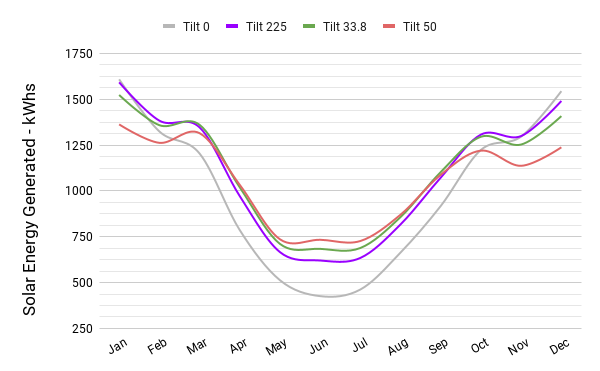
The end result is the higher the tilt, the more solar energy is produced in winter. Then, on the flip side, those higher tilts produce less energy in the summer months.
The solar system modelled above is a 10.2 kW system split with 6.2 kWs facing northwest and 4 kWs facing north for her home in Melbourne.
A 33.8 tilt will generate 10% more energy in June compared to a 22.5 tilt
The higher the tilt, the better solar production in winter. The 50-degree solar panels produce the most energy from May to July. With the 33.8 tilt still having modest winter gains as well.
Overall, in June, the 50-degree panels will produce 18% more solar energy than the 22.5-degree tilted panels. But then, in summer, it swings the other way, and the 22.5 tilt comes out on top.
Naturally, sunlight is harder to come by in the winter months, so squeezing out 18% more solar energy is quite the boost.
Though the most important measure of success is if that extra solar energy will be used and is helping the home when they need it most.
In my mum's case, her actual solar consumption hardly change from one tilt to the other, the consumption lines are nearly identical. This is because she consumes most of her energy towards the early morning and end of the day and with a 10.2 kW system she is already using all the solar energy she needs regardless of the tilt optimisation.
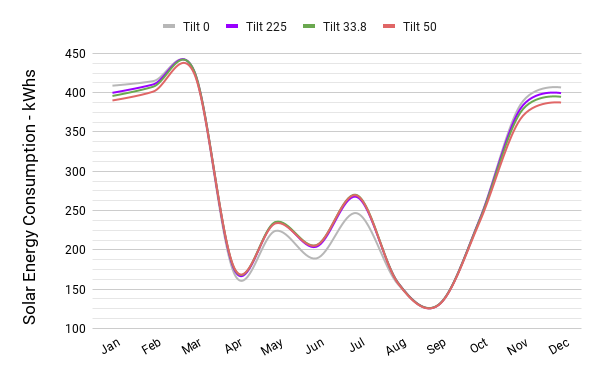
There isn't even the benefit of exporting more feed-in tariff credits to the grid once we consider the decreased solar energy generated in summer for the higher tilts, like 33.8 and 50. Overall, she would produce fewer feed-in-tariff credits or barely more than usual to even mention it.
The amount of feed-in-tariff credits each system would generate over a year are:
22.5 degrees produces 9780 kWh's in credits
33.8 degrees produces 9850 kWh's in credits
50 degrees produces 9346 kWh's in credits
In Melbourne, a feed-in-tariff credit per kilowatt is around 4¢, so in the end, we are talking about a few extra dollars out of the whole year, if we optimised for 33.8 degrees and those feed-in-tariff credits.
Unless you have the 60¢ super tariff credits, this kind of analysis will not be worth looking into, making a few dollars isn't worth your time and investment.
The end verdict is that the tilt is not going to matter that much for most homes
If your home uses a lot of energy in the winter months during the afternoon and you need that extra solar squeezed out, then consider tilting your panels.
However, it will most likely be more beneficial to try and fit in more panels on your roof than trying to do complicated tilts outside your roof's natural angle. Also with a complicated tilt comes more issues, like the installation process.
In the end, it comes down to the energy consumption patterns of your home and what you want for your roof. Like everything in solar, there is no one-size-fits-all solution. It depends on the family living in the home and how they use their energy throughout the day.
Access your energy consumption data to model a solar system based on your consumption patterns
If you have a smart meter and want to use your energy consumption data to see how solar systems of different sizes will decrease your energy costs and increase your savings, then you should use our new app at SolvingZero.
We can read the energy consumption data from any smart meter in the country in just a few clicks. It's free, and it takes about 45 seconds to link your meter online.
Once your data is linked in our app, you will see all of your consumption data in your own dashboard. We also built a tool to simulate how different solar systems will lower your energy costs, based on your actual energy consumption.
If you want to try it out, just let me know, and we can chat!