

Comparing different hot water system costs
An in depth analysis of how much different hot water systems cost to buy an install. Then a comparison of how much they cost to run and what their lifetime value would be overall.

Sam Bendat
Updated: August 20, 2024
This week we're calculating what type of hot water system will save more money.
The analysis looks at the costs of purchasing a system, installation, added rebates, and running costs over five to fifteen years.
The quick bottom line
Reverse cycle hot water heaters - also known as heat pumps - win as the most cost-effective system as a long-term investment.
In the table below is a breakdown of the most common hot water systems and their total costs.
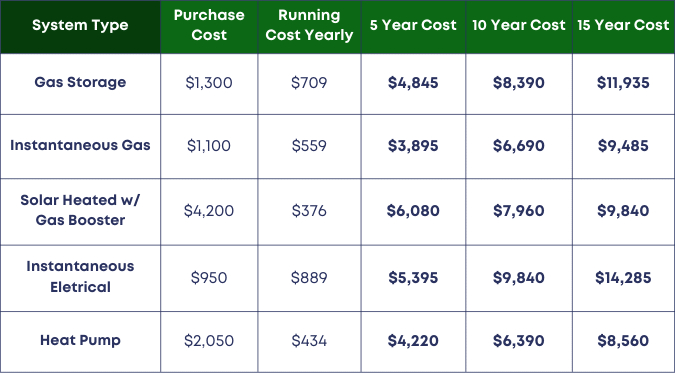
The data assumes an electricity rate of 31.9¢ for a peak rate and 25¢ for off-peak. The gas price is 3.3¢, which is pretty generous, normally electricity can be found cheaper, which would reduce the running costs for the electric devices.
We also consider the supply charge for both electricity and gas but have standardised it so gas and electricity have the exact same charge of $264 a year.
Included is an approximation of the installation costs and any government rebates that would be available for the system. This is all calculated for a typical two-person home in Melbourne.
If you'd like to check out the data used for the above table then you can find it on the Sustainability Victoria site.
For those outside of Victoria, the $1000 rebate won't apply to the solar heated system and the heat pump system, but the STCs will. However, depending on the state and region gas might be more expensive, so that would shift the numbers in favour of the electrical devices.
It's also important to note that there is also the caveat that electricity and gas prices change over time. The running costs above are not set in stone and will increase. Though given market movements over the next five to fifteen years this will probably benefit electricity users more than gas users.
I'm not feeling so gassy anymore
Gas storage comes in as the second most expensive option out of any device on the list as storage requires immense amounts of energy to keep water warm throughout the day. In a cold climate this would increase exponentially, sorry Tassie.
Also as we see, instantaneous gas is actually a somewhat appealing option in the short term, taking advantage of the somewhat cheaper gas prices while they last and a fairly cheap up front cost.
However as gas continues to be phased out of the market over the next 10 to 15 years the price will only continue to increase. Eventually, the price will become so expensive that the prices will blow out far above what is predicted above and the savings will become a major cost.
A gas-banning program has already started to take shape in Victoria.
Going solar or instantaneous electrical
There are two obvious choices here: a solar hot water system or a solar system hooked up to an instant electrical water heater.
So let's separate these out and see which is the bigger money saver.
Solar hot water system with a gas booster
The short and skinny is installing a solar hot water system, which only makes sense in a sunny climate, otherwise, in the colder less sunny months there needs to be an electrical or gas booster system to periodically jump in to heat the water.
The total investment for a solar water system will start around $3000 for the electrical boost systems and can go as high as $6000 for gas-boosted systems, which includes the installation but not government rebates.
Run over the long term the gas booster system might be a cost saver because the gas rate is around 3¢ to 4¢. However, when taking into account paying for a gas supply charge each billing period it quickly loses that edge. Not to mention the huge up-front cost.
Unless we're in Darwin its going to be hard to save cash over the long term. It also means valuable roof space will be taken up by the hot water system, so there will be less space for a normal solar system.
Instantaneous electrical + solar
If electricity bills seem high now, then wait until installing an instantaneous electrical water heater. Heating up water fast with electricity is not a simple task.
While this option always seems appealing with the low up-front cost we are basically throwing money into an electrical fire over the lifetime of the device.
The only upside is if we have solar, then we can attempt to divert solar energy to the water heater, the problem is the water heater is so power-hungry within short bursts that unless there's a battery or a truly massive solar system we'll never have enough solar energy on hand to power the heater to its needed capacity.
So at this point, we may as well buy the heat pump because the instantaneous electrical requires a huge investment of $18,000 for a supporting solar system and battery.
When investing in the electricity of a home it doesn't make sense to cheap out with an instantaneous electrical hot water heater. It just shifts the cost and more down the line.
Best on ground - the heat pump
With the second-highest up-front cost the heat pump takes the lead by paying in dividends once it's up and running.
But even with that high upfront cost within five years we're already ahead of most devices in terms of running reductions in cost. In the above analysis, I was using a 270L iStore model heat pump, which is a solid highly regarded middle-tier heat pump.
There are cheaper and more expensive heat pumps out there but for the sake of this argument, I went with middle tier devices and services to play it safe.
One important note, though is in the above calculation, we are factoring in a $1,000 rebate to reduce the overall purchase and install cost of the heat pump. Just about everyone can claim credits on their purchase through the federal STC program, which I talked about in the last newsletter.
Combining solar with a heat pump
There are more calculations to be done around installing a solar system and what benefits that would bring to the heat pump or other systems. Or if installing solar is better for the bottom line than upgrading the hot water heater.