

Is a battery worth it in 2024? The yearly savings
We calculated how much money a solar system would save my mum over a year. Then we looked at how much solar and a battery would save her. Batteries still have a ways to go.

Sam Bendat
Updated: August 20, 2024
Batteries and solar analysis this week.
I will be looking at how much money can be saved by installing solar and a battery in a home.
I am using my mums home as an example to see how much she could save on her $2000 a year energy bill if she installed a 7.6kW solar system and a 13.5kWh Tesla Powerwall 2 battery.
A battery would save her roughly $640 a year
Around $780 is saved by directly consuming the solar energy generated, and a further $640 is saved by using the battery to store solar energy and using it later.
These costs and savings are based on the Origin Go Variable Solar plan, which has a peak price between 3pm and 9pm every day of 29.01¢ and an off-peak price at all other times of 19.04¢.
The total savings would change quite a bit depending on the plan she's on, and it's important to note there would be some room for optimisation around that. I chose Origin because it's one of the most popular plans out there, and it's who she is with currently.
The below graph shows the cost of her energy bills per month normally, with solar, and with solar + a battery.
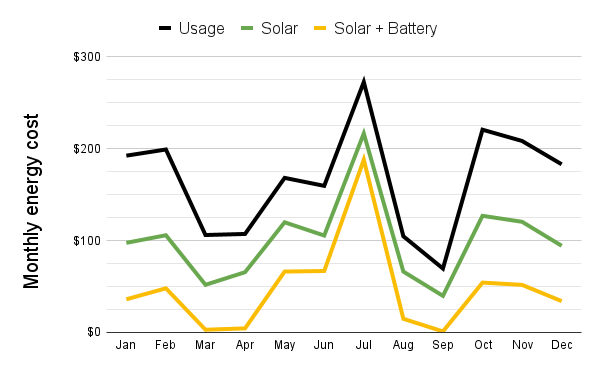
It's a bit hard to notice, but the solar makes a big impact on her costs during the summer months, and in the winter, the savings are less significant.
From an hourly standpoint, given her peak plan costs line up with the afternoon and evening, she generally uses solar or battery energy during that peak time without trying to optimise the battery cycles to align perfectly with these times.
Calculations and factors that were left out for today
I didn't consider maximum charging and discharging rates for the battery, a few leftover feed-in-tariff credits, reserve battery settings, possible grid consumption to feed the battery, or anything not mentioned that I still need to include!
If there is enough interest, I can calculate these other factors into a more comprehensive analysis in the future.
How I gathered all the data for the calculations
To get my mum's energy consumption, I can access her meter data as SolvingZero is authorised to read energy data from any smart meter in Australia with the permission of the homeowner.
I can do this for your home too, if you want. Check the end of the article for more details.
For the solar data, I was able to get that from the local weather stations in Melbourne, using eight years of data and weather reports. I arranged her solar system 50% on her north-facing roof and 50% on her west-facing roof.
I used all of this data to model how her consumption patterns line up with the solar generation capabilities of her roof.
Calculating the solar and battery consumption
To line up her consumption and the solar data I used monthly averages for hours of the day to try and smooth out any abnormal spikes in her consumption or the solar data.
The end result was the amount of solar energy my mum would consume and how much she would feed back into the grid for credits with a 7.6kW of solar.
To make the calculations simpler, I assume that when my mum is using energy and her solar is producing energy, she will use that solar energy. Any leftover solar energy then goes into charging the battery.
For the time being I didn't try to do any tricky optimisations of sending solar energy to the battery while it could have offset her consumption in that moment. This could lead to a further cost reductions and savings if done right.
Charging the battery and discharging for energy use
This was one of the more complex calculations that can increase exponentially relative to how deep we dig. For the battery I assumed a round trip efficiency of 90% for the battery due to a standard 10% efficiency loss.
I then simulated the charge and discharge cycles according to the remaining available solar energy. As the battery charges it can reach maximum capacity with the excess solar, when no more solar energy is being produced for the day we switch over to discharging and using the battery. I calculated this for every hour of the year.
The final results were multiplied by the respective peak/off-peak pricing to create the final dollar value totals.
My mum saves a lot but its not quite enough, yet
In the end, the final predicted cost of my mum's energy bill is around $570, which is a 72% decrease overall from her normal consumption costs. However, a majority of that reduction is attributed to the solar system.
With a predicted $640 in yearly savings for utilising the battery, it's unfortunately still a ways from breaking even with the cost of purchasing and installing a battery, considering a Tesla Powerwall 2 would cost around $14,000 purchased and installed.
At that price point, we need to reach a yearly payback of around $930, and even with factoring in more optimisation to the calculation, I don't see the $641 rising by 45% to reach that break-even point.
This being said, the Telsa Powerwall 2 is expensive and not necessarily the most economical option. Finding better deals on batteries and tweaking the solar system size to a larger system with a more optimal roof alignment would help to shave more off her grid consumption.
Though as battery factories continue to ramp up around the world battery prices will most certainly continue to drop. It's not a question of if batteries will be economically viable for a home but when.
There have also been many murmurs of new battery rebate programs rolling out over the next year or two. And in the end, for many current battery owners they don't put a price on complete energy independence and freedom from the grid, that peace of mind if invaluable.
If you want to analyse your energy for free
If you would like to see if solar or a battery is right for you, then you should check out what I have been working on.
SolvingZero is an app that allows anyone with a smart meter to use their own energy consumption data to see how they can save on solar, a battery, swapping out a gas appliance, or choosing the right energy plan.
Let me know if you'd like to try it out, and I can set you up. It only takes a few clicks, no hardware or home visits are needed, and it's free. Reply to this email, and we can chat!
More battery analysis if you would like
This battery analysis is a deep rabbit hole, if you found it interesting and you would like to keep going then let me know. I think there is more to be done around calculating a larger solar system and a more affordable battery size.