

My mum's energy and her wine fridge
I explored my mums energy consumption patterns and how a hypothetical solar system would offset her energy costs for her apartment in Melbourne.

Sam Bendat
Updated: August 20, 2024
The first newsletter! This week I'm gonna take a look at my mum's energy usage, how she could upgrade her house to solar, and what that would mean for her energy bills.
Her energy usage averaged by hour
First up, this is what her energy usage looks like if we average every day of the year by the hour of the day. The below chart is using a year's worth of data.
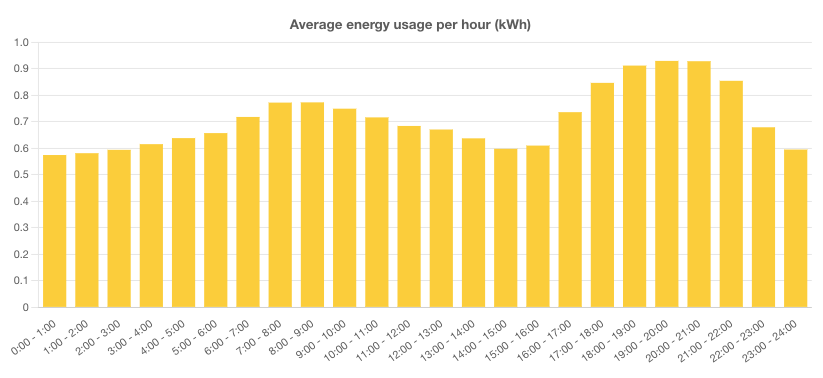
For one person, she uses quite a lot of energy, above we can see she consistently averages half a kilowatt per hour. She has a wine fridge that gets hit by a lot of sunlight, and it's an energy monster.
For context, a kilowatt is like running a 100-watt light bulb for 10 hours, so for each hour she has at least five 100-watt lightbulbs running. However, these days a standard LED lightbulb emits around 12 watts (for a 100-watt equivalent). So it'd be the equivalent of running 47 normal-sized LED lightbulbs for an hour, that's a lot of light!
Looking at her daily usage pattern, just like everyone, my mum's energy spikes from around 5 pm to around 10 pm. On average, she pays $4.57 a day for her electricity.
Given her usage patterns if she was thinking about buying solar panels, would that really help her? All her usage is skewed towards the end of the day, right?
Let's take a look.
Would buying solar make sense?
With the tool I've built, we can experiment with installing different-sized solar systems. By fine-tuning the system details in the tool we can find the optimal system for her usage.
Let's say in a hypothetical case my mum can fit as many panels as she wants on her roof, all facing eight degrees from due north. We can play around with the solar tool and dial in a tilt of around 34 degrees as the ideal sweet spot.
With a bit more trial and error on the system size input we find that at around 11.5 kW her house would produce enough energy on average to cover her usage over a year.
But in this setup she would be heavily dependent on feed-in-tariffs, which for her home is currently at 4.2¢, and decreasing every year, not ideal.
If we dial down the solar system to size to a smaller 6kW system, we can maybe be a bit less dependent on feed-in tariffs and just focus on her energy usage being offset by solar energy.
Payback period for the solar system
By doing some quick research it looks like a 6kW solar system in Melbourne costs around $5,200 to $8,700. Thanks to an incentive that subsidises that cost, she gets a fairly reasonable price.
By doing some back-of-the-envelope math, we can get a rough idea of her payback period. If her feed-in-tariff stayed at 4.2¢ her payback period would be around...
3 to 5 years
Given that it's more realistic that the feed-in-tariff will gradually reach zero over the next few years, we could forecast a worse-case scenario. If the feed-in tariff was set to zero tomorrow, what would her payback period be?
5 to 7 years
Still, it's pretty reasonable. Considering a solar system has a 20-year plus warranty, she will be unlocking significant future value.
What aren't we looking at yet...?
As you can probably tell, we only really scratched the surface in this analysis.
To solve the question of my Mom's energy usage, we might be able to dial in a solar system even more to her exact usage patterns. We could forecast a decreasing feed-in tariff over the next few years to get an exact payback period. She could buy an EV and store some of the solar energy to use later in the day. She could replace her wine fridge...
This analysis is just getting started.
If you find this interesting let me know, and I can go deeper into a certain aspect of my mums energy next time around.