

Questioning conventional wisdom on solar orientation
If the home consumes energy mostly in the early dawn hours or the evening hours does pointing all of the panels due north still make sense? Its something I looked into and calculated out.

Sam Bendat
Updated: August 20, 2024
This week, the wasted potential of solar placement
Which is a topic that can be summed up in one question... Is it best to optimise solar panel placement for the maximum solar output - facing north - or optimise to offset personal energy usage?
This stems from the fact that as solar becomes more prolific in Australia eventually all the feed-in-tariff incentives will come to an end, and in some instances, most likely turn into fees a homeowner will pay each month to own their solar system.
It stands to reason a home will be better suited to offset its own usage rather than optimising for maximum solar output and feed-in-tariffs.
Team face them north has a huge lead
It's a simple fact that in the land down under, the most optimal direction to point solar panels is a few degrees off of due north.
Also, historically, the electricity market has incentivised facing panels north by providing feed-in-tariff credits to homeowners for generating electricity. In some instances, these incentives were as high as crediting the homeowner ¢60 a kilowatt.
If we consider that most energy plans today cost around ¢20 to ¢30 a kilowatt, it's clear how big these incentives were. Today the feed-in-tariff incentives are around ¢3 to ¢12 a kilowatt and continue to decrease year-on-year.
But the result of these incentives has been huge for team north. Solar panels on rooftops can generate anywhere from 25% to 45% of all energy needs for Australia during the afternoon.
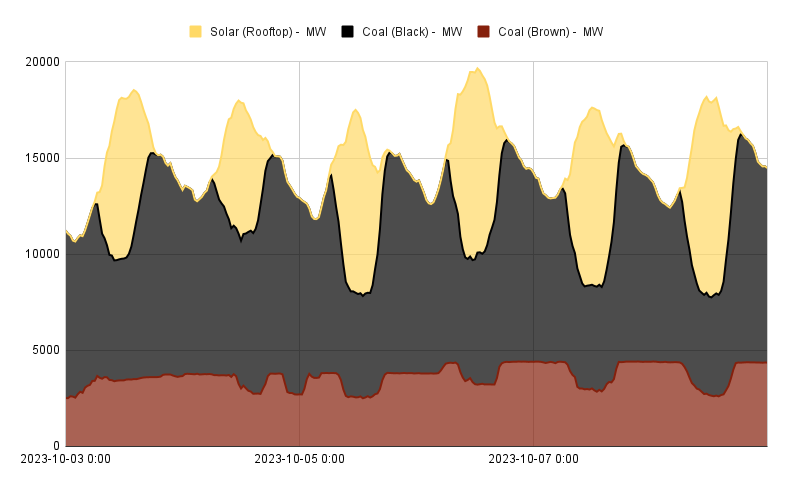
Below we see the daily energy generation of solar vs coal power in Australia from October 3rd 2023, to October 8th 2023. Those yellow solar spikes line up to around noon every day.
If we zoom into October 6th, we see a breakdown by hour of a typical solar generation. Starting at around 7:30am solar begins to wake up and begin pumping energy into the grid. By around 4pm all the north facing panels begin to lose their edge and the solar generation decreases rapdily.
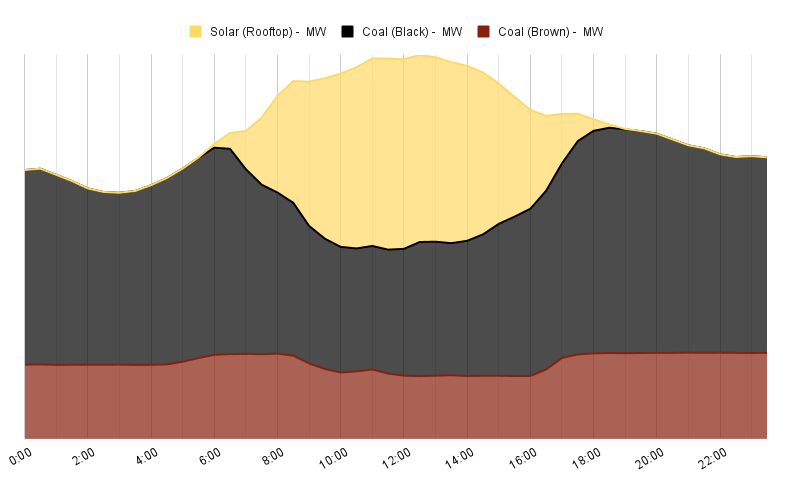
4pm seems a bit early for bed
In a 2020 study, the University of South Australia released a research paper about solar panel orientation, stating,
"panels should initially be placed facing north-west... if more panels area is available, the optimal configuration has fewer panels facing north-west and more facing north-east and west."
An unfortunate fact for team north is that most homes use a majority of their energy in the morning and in the evening. The evening in particular is a big period of energy consumption when people get home from work, start cooking, watch tv, turn on lights and so on.
It therefore stands to reason to try and harness more energy from the sun during these hours when energy usage for a home is at its highest.
The same damn energy graph strikes again
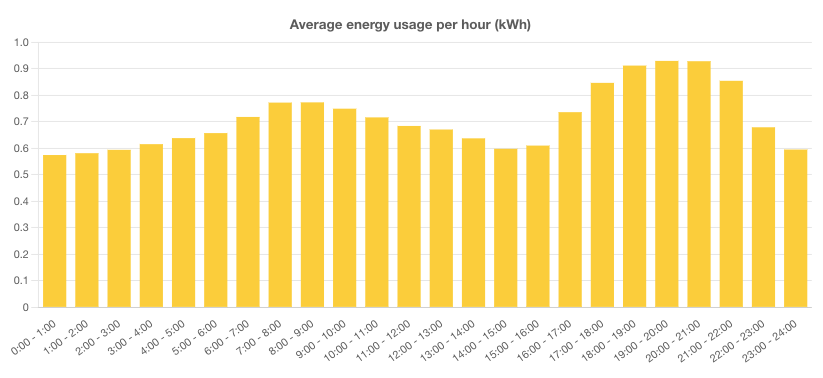
I know I use this graph a lot. It's the third time out of four newsletters so far! But it's so damn helpful and illustrative.
Above is my mum's energy usage averaged by hour of the day, which is fairly typical for an Aussie home. Her energy increases in the morning and then spikes in the evening.
If we scroll up and look at the solar generation curve from before, we see the mismatch in generation and usage by hour, especially in the evening hours.
The simple solution
t's clear, face the panels to maximise the solar radiation when we're home and using energy, not for feed-in-tariffs. Easier said than done.
These kinds of calculations require the personal energy usage pattern of the home and a detailed solar radiation map of the rooftop for these specific hours of the day.
With this data, we could then calculate a solar generation forecast to place panels in the most optimal position for the homeowner. As a result, it provides a solar system that does what it means, to offset and reduce the reliance on energy from the grid.
Unfortunately, a calculation that is rarely made for new prospective buyers of solar as getting your usage was too difficult. At least it was!
A shameless plug... If you haven't already, you should sign up for the SolvingZero energy dashboard. Pretty soon, you'll be able to see your exact energy usage patterns on your own personal dashboard, like in the graph above. Then you too can make informed decisions about your home and any future solar plans.